
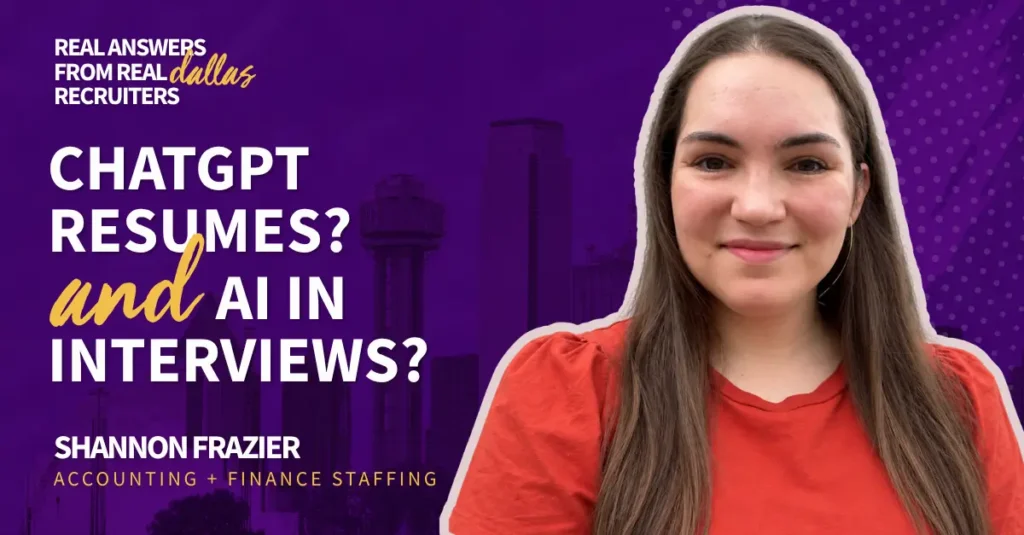
Real Answers from Real Dallas Recruiters, with Shannon Frazier, PrideStaff Financial in Dallas
Yes, on both. Recruiters spot AI on a resume through leftovers like an unfilled “[Insert quantifiable achievement]” or a chatbot note asking you to confirm your numbers. Hiring managers spot it in interviews through eyes drifting to another screen, typing mid-question, and answers that sound memorized. In a TopResume survey, the hiring managers who caught AI-written resumes did it in about twenty seconds.
This month, Shannon Frazier from our Dallas team takes on both questions. If you’re job hunting, she’ll show you where AI helps your resume and where it hurts you. If you’re hiring, she’ll walk you through what AI use looks like in an interview. Shannon cares whether the person on paper matches the person in the room.
Connect with Shannon on LinkedIn.
For Job Seekers: What Recruiters Notice on an AI-Written Resume
Recruiters can often tell, and they care less that you used AI than whether your finished resume is accurate, proofread, and true to your experience. Here’s how Shannon puts it:
“In a perfect world, I will not be able to tell if you’ve used ChatGPT, but things that do stand out is when very specific things are bolded. That’s usually a clear sign. And if there are prompts that you have not deleted, or empty spaces that you have not deleted.”
Shannon Frazier, Staffing Consultant, PrideStaff Dallas
In TopResume’s survey, 33.5% of hiring managers correctly identified AI-written resumes, and 19.6% said they’d reject one that looked fully AI-generated. Resume Genius’s 2026 Hiring Trends Report ranked heavily AI-generated application materials as the second most common red flag in hiring, at 49%, behind only job-hopping.
Shannon’s fine with you using it, as long as it’s cleaning up your own words:
“If you want to use AI, I think it’s a great tool to kind of summarize and tidy things up and make things have a clean format. So I’m all for that, as long as … your resume accurately reflects your experience, your job duties, and is … just an honest interpretation of who you are as a person and a candidate.”
Most hiring managers agree. TopResume found 52% think AI help with proofreading or drafting is fine if the final resume reflects you, and only 14.5% said you shouldn’t use it at all.
The Giveaways We See in Resumes Sent to Our Dallas Office
| What we see | Example | What it tells a recruiter |
|---|---|---|
| Unfilled placeholders | “[Insert quantifiable achievement]” or “[skills]” | Nobody proofread it, and key details are missing |
| Leftover AI notes | A line reminding you to confirm your stats | The AI’s suggestions were pasted in without a read |
| Random bolding | “Managed vendor relationships and streamlined reporting” | The formatting came straight from a chatbot |
| Inflated numbers | “Reduced month-end close by 40%” from an entry-level AP clerk | The number may not hold up when we ask about it |
| Generic duties | “Results-driven professional with a proven track record” | We still don’t know what you did all day |
Our applicant tracking system won’t reject your resume because AI helped write it. We can only speak for our own system, and other companies set theirs up differently. Your resume is still your first impression, though, and “[insert college degree here]” on an application for a detail-oriented role is a hard one to come back from.
Empty brackets also keep you out of searches. When your resume comes in, your degree, skills, certifications, and awards get pulled into our system, and recruiters search those details when a new role opens. If your resume says “[skills]” where your skills should be, you won’t show up, even if you’re a great fit.
Inflated numbers are the bigger risk in accounting and finance, where accuracy is the job. A hiring manager in Las Colinas who sees “saved $2M in costs” on a staff accountant’s resume is going to ask how, and if you can’t walk them through it, the number works against you. Plenty of people take that chance: GCheck’s 2026 Trust in Hiring Report found 59% of recent job seekers admitted inflating the impact or scope of past roles.
Using AI on Your Resume Without It Showing
Write it yourself first, then use AI as your editor. It does a good job helping you say what you mean, and a bad job deciding what you did.
- Write the first draft yourself. List your jobs, duties, school projects, software, and results in your own words, and don’t worry if it’s messy.
- Ask AI to edit, and keep the content yours. “Tighten this bullet” or “fix the grammar and keep my wording” keeps you in control. “Write me a staff accountant resume” hands it over.
- Search for “[” and “insert” before you send. Fill in every placeholder and delete any notes the AI left for you.
- Check every number. If you couldn’t explain it in an interview, change it or cut it.
- Undo the random bolding so your formatting matches from top to bottom.
- Read it out loud. If a line doesn’t sound like something you’d say, rewrite it until it does.
- Have a recruiter look at it. Going over your resume with you is part of what we do at PrideStaff in Dallas, and it doesn’t cost you anything.
The same goes for cover letters, your LinkedIn profile, and follow-up emails.
For Hiring Managers: What AI Looks Like in an Interview
Some candidates are using it live. A Gartner survey from the third quarter of 2025 found 13% of job candidates used generative AI in real time during an interview, and 41% of that group used it to come up with answers to the interviewer’s questions. Shannon has seen it:
“Some candidates do, but it’s usually pretty obvious if they’re looking at another screen, trying to type in questions, or if their questions sound super ultra scripted. Those are yellow flags to look out for.”
Shannon Frazier, Staffing Consultant, PrideStaff Financial in Dallas
Prepping with AI is fine. Where most hiring managers draw the line is real-time help. In TopResume’s survey, 57% said tools that generate answers during the conversation shouldn’t be used, because they keep you from getting a fair read on the candidate’s skills.
The Yellow Flags Hiring Managers from Plano to Irving Notice
- Their eyes keep going to another screen, especially right after you ask something.
- You hear typing while you’re still talking.
- There’s a long pause before every answer, even the easy ones.
- Answers sound like a written essay instead of a conversation.
- A strong first answer falls apart when you ask, “Can you tell me more about that?”
- They never stumble.
That last one surprises people. Shannon explains:
“I think it’s a good thing when candidates prep, but if they can’t have authentic answers, or maybe don’t make any mistakes, that might be a warning sign that they’re using AI.”
Questions a Script Can’t Keep Up With
No interview format is foolproof, and how you handle suspected AI use is up to your company. Conversation is still your best tool. Gartner points out that AI can explain a technical topic well, but it can’t supply someone’s personal experience, and it’s less effective on follow-up questions that dig into how someone thinks. Ask “Tell me about a time a reconciliation didn’t balance and what you did,” then ask what they’d do differently, and you’ll get a conversation a script can’t follow.
If you’re hiring through PrideStaff in Dallas, Shannon and our team talk with candidates before you meet them, so you’re meeting people we already know.
Both Sides Want to Meet the Real Person
Recruiters and hiring managers are trying to get to know you, your skills, your goals, your personality, and your flaws too. A perfectly scripted application or interview gets in the way of that.
We get why people reach for AI. Interviews are nerve-racking, and GCheck found 72% of recent job seekers feel more pressure to embellish to stand out. It tends to backfire, though. In the same report, 25% of candidates who misrepresented themselves ran into problems at work because their skills didn’t match their resume.
If you’re job hunting, practice with AI if it helps, then put it away and go in with stories from your own work. A slightly imperfect answer that’s true tells a hiring manager more than a flawless one from a chatbot. If you’re nervous, it’s ok to say so, and if you don’t know something, say how you’d find out. Resume Genius found 79% of hiring managers say enthusiasm and a positive attitude make them more likely to hire someone, which helps when your experience is still thin.
If you’re hiring, a candidate who pauses to think or admits they’re nervous is showing you who’ll show up on day one. That’s usually a good sign.
Talk to Shannon
Job seekers: If you’re a new grad or moving into accounting or finance from another field, send Shannon your resume. It’s free.
Hiring managers: Tell Shannon what you’re trying to fill, and she’ll tell you whether we’re the right shop for it. Call (972) 661-1616.
About Shannon Frazier
Shannon is a staffing consultant at PrideStaff Dallas, where she’s spent nearly two years placing people in accounting and finance roles across Las Colinas, Irving, Richardson, Addison, and Plano. She has a soft spot for new grads and career changers, the people most likely to lean on AI because they aren’t sure how to describe what they bring. PrideStaff Dallas has been placing people in Dallas for 25+ years, and you’ll work with the same local team from your first call through your placement.
Connect with Shannon on LinkedIn.
Video Transcripts
Candidate Question: Can you tell when a resume was written by ChatGPT, and do you care?
“In a perfect world, I will not be able to tell if you’ve used ChatGPT, but things that do stand out is when very specific things are bolded. That’s usually a clear sign. And if there are prompts that you have not deleted, or empty spaces that you have not deleted.
If you want to use AI, I think it’s a great tool to kind of summarize and tidy things up and make things have a clean format. So I’m all for that, as long as at the end of the day your resume accurately reflects your experience, your job duties, and is, yeah, just an honest interpretation of who you are as a person and a candidate.
My name is Shannon with PrideStaff Financial. I’ve been assisting with accounting and finance roles for going on two years now. If you’re a new grad or looking to make a career change, I would love to connect with you and see how we can assist you in finding your next position.”
Client Question: Are candidates using AI to get through interviews? How do you catch it?
“Some candidates do, but it’s usually pretty obvious if they’re looking at another screen, trying to type in questions, or if their questions sound super ultra scripted. Those are yellow flags to look out for.
I think it’s a good thing when candidates prep, but if they can’t have authentic answers, or maybe don’t make any mistakes, that might be a warning sign that they’re using AI.
My name is Shannon with PrideStaff Financial. I’ve been working with PrideStaff for two years and would love to connect and see how we can assist you in finding your next top candidate.”